

Christmas Closing Dates 2025
As we get closer to the festive period we would like to take a moment to update you on our Christmas closing schedule. Christmas Closing Dates Our final date for
In the dental decontamination cycle, cleaning is the critical, underpinning step. Instruments that haven’t been thoroughly cleaned cannot be reliably sterilised — organic soil and tissue residue shield microorganisms during sterilisation.
In this article, we take a detailed look at what cleaning actually means in a dental context, the methods available to UK practices, and the cleaning chemistries available.
The word “clean” is highly contextual. In a domestic setting, you might clean cutlery until it is free from food residue and acceptable for the next meal. However, this standard falls short of the requirements for dental instrument reprocessing. Conversely, the dental standard of cleanliness might still not meet the “clean” standards required in a pharmaceutical setting.
In dental decontamination, “clean” refers to a specific outcome: the removal of organic soil, proteins, blood, and tissue residue to a level that ensures sterilisation is successful. An instrument may appear clean during inspection, yet it can still harbour residual proteins; these microscopic layers can shield microorganisms during sterilisation.
The cleaning stage necessitates the precise application of chemistry, equipment, and processes to ensure patient safety.
A simple framework for understanding cleaning is the Sinner Circle. Developed by Herbert Sinner, he described cleaning as a process of 4 variables: Mechanical Force, Chemistry, Time and Temperature.
As a domestic example, a washing machine uses a combination of Mechanical Force (the spinning of the drum), Chemistry (washing detergent), Time (cycle length) and Temperature (water temperature).
Crucially, if one variable decreases, one or more variables must increase to compensate. In our washing machine example, running an eco cycle reduces the water temperature in the machine. To compensate for the lower temperature, the washing machine has a longer cycle and applies more mechanical force to clean the clothes.
We can use the Sinner Circle to easily understand how cleaning works for the different methods of cleaning in dental decontamination. For manual cleaning, we use a combination of scrubbing (mechanical force), detergent (chemistry), temperature-controlled water (temperature) and scrubbing time (time) to clean instruments.
The SINNER circle — all four factors must work together. Reduce one and the others must compensate.
Understanding the Sinner circle helps practices ask better questions about their cleaning process. Not just “is it clean?” but “did our chemistry, temperature, contact time, and mechanical action combine to deal with the specific soiling we’re working with?”
Not all cleaning solutions are equal. It is essential to understand the applications, strengths and weaknesses of the products used in a dental practice for instrument cleaning.
Alkaline Cleaners
Alkaline cleaners work at a high pH to denature organic substances into water-soluble components, allowing them to be washed away. Alkaline cleaners have broad-spectrum efficacy against organic soils and are the chemistry of choice in washer-disinfectors. High alkaline cleaners (pH above 12) are also highly effective at reducing prion infectivity (Fichet, G., et al. 2004).
The most noticeable drawback of high alkaline cleaners is material compatibility. Aluminium, brass and low-grade stainless steel can be damaged by highly alkaline cleaners. It is important to check that your instruments are compatible when using alkaline cleaning chemistries. Highly alkaline cleaners are caustic and must be handled with care and with appropriate PPE.
Enzymatic Cleaners
Enzymatic cleaners use enzymes, biological molecules that break down organic components into water-soluble components. Enzymatic cleaners are highly effective at removing organic substances and are suitable for use on sensitive materials. As enzymatic cleaners are usually pH neutral, they are safer to handle than alkaline cleaners.
A primary disadvantage of enzymatic cleaners is their inherent instability. Because these solutions contain enzymes designed to break down proteins, they are affected by a process known as autolysis. Essentially, the enzymes begin to digest one another during storage, causing the solution to degrade and be less effective over time. This degradation process is further accelerated by high temperatures. This means the cleaning performance of a fresh bottle may differ from that of the same bottle months later, introducing a variable that is undetectable without routine validation.
Neutral Detergents
As the name suggests, Neutral Detergents without enzymes sit at a pH of 7. Neutral detergents use surfactants to reduce the surface tension of water, lifting contaminants away.
The primary benefit of Neutral Detergents is material compatibility, as they are neither acidic nor alkaline, sensitive instruments will not be damaged during cleaning. They are also safer to handle compared to alkaline cleaners. The lack of enzymes means they are more stable and have a longer shelf life than enzymatic cleaners.
Whilst safe and gentle to instruments, Neutral Detergents lack cleaning power compared to enzymatic cleaners.
| Feature | pH-Neutral | Enzymatic (Liquid) | Alkaline |
|---|---|---|---|
| Primary Action | Surface Tension Reduction | Biological Digestion | Chemical Saponification |
| Material Safety | Excellent | Good | Check instrument compatability |
| Stability | High | Low (Autolysis) | High |
| Cleaning Strength | Moderate | High (Protein specific) | Very High |
| Example Product | Hospec pH Neutral Detergent | Prolystica Enzymatic Cleaner | TR3 Mild Alkaline Cleaning Solution |
In a dental setting, there is 3 primary methods used for instrument cleaning before sterilisation.
Manual Cleaning
Manual cleaning is an acceptable method of cleaning instruments under the essential quality requirements of the HTM01-05. For best practice, however, the primary method of decontaminating instruments should be an automated system.
Due to human factors and the number of variables, manual cleaning cannot be validated. This is why an automated system is preferred, as it ensures repeatability and the process can be validated. Manual cleaning carries the highest risk of sharp injuries for users.
Implementing a robust manual cleaning protocol is essential to reduce variability and ensure the safety of operators carrying out the process.
For a more in-depth look at manual cleaning, click the button below.
Click a segment to see its role in manual cleaning
Ultrasonic Cleaning
Under HTM 01-05, ultrasonic cleaning is categorised as an optional step; it is not required for Essential Quality Requirements (EQR) or Best Practice.
It is, however, preferable to manual cleaning, as it improves operator safety and the process can be validated. Space constraints and installation costs mean that not every practice can accommodate a washer-disinfector; in these instances, an ultrasonic bath becomes vital. It offers a level of cleaning consistency and safety that manual cleaning cannot achieve.
To ensure effective operation, Ultrasonic Cleaners should be degassed at the start of every session. Open any hinges and joints fully to clean these crevices. Ensure the bath is not overloaded, as this can inhibit the cleaning action. Never reprocess handpieces in an ultrasonic bath. Finally, refresh the water and cleaning solution at the end of every session or when it is visibly soiled.
Click a segment to see its role in ultrasonic cleaning
Ultrasonic cleaning automates mechanical action, but requires precise chemistry and degassing to be effective.
Washer Disinfectors
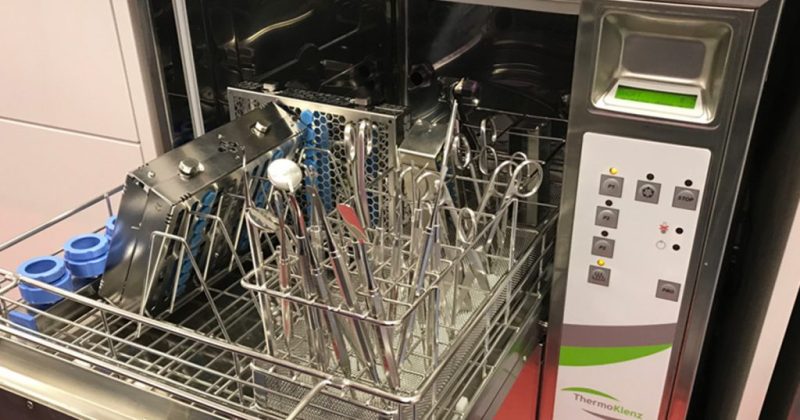
Automated Washer-Disinfectors are the preferred method for cleaning and reprocessing reusable dental instruments. To achieve Best Practice under the HTM01-05, a washer-disinfector is required.
Washer-Disinfectors use a 5 stage-process based on impingement; high-pressure water jets physically remove debris. Upon completion of the cleaning stages, the instruments are thermally disinfected, further reducing microbial count on instruments.
The process is automated, consistent, and can be validated. It is considerably safer for operators compared to manual cleaning.
For a more in-depth look at washer-disinfectors in dental, click the button below.
Click a segment to see its role in a washer-disinfector.
In a Washer-Disinfector, all four variables are monitored and recorded, removing human error from the cleaning cycle.
Need help with your cleaning processes or any part of the decontamination cycle? Get a free review of your decontamination procedures from our expert team — fully tailored to your practice.
Book Your Free Review →Completely free
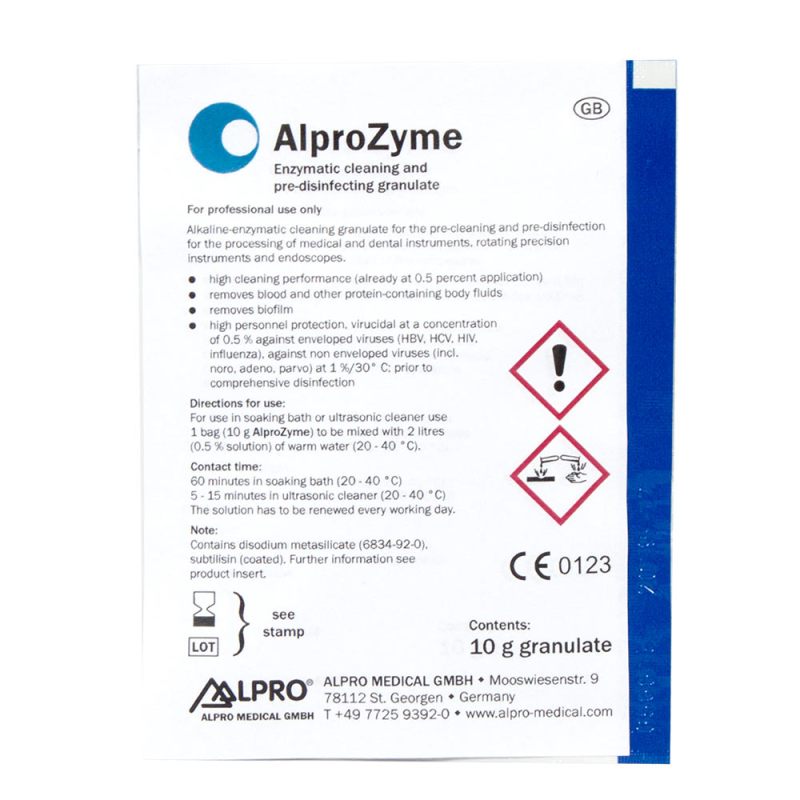
AlproZyme
Dual Action Cleaner
AlproZyme combines both enzymatic and alkaline cleaning in one product for an outstanding cleaning effect. AlproZyme is supplied granulated which means it is more stable than regular enzymatic cleaners, the first sachet will clean just as well as the last.
Request a free sample
Understanding cleaning chemistries and the cleaning processes available in dentistry allows us to better match detergents and methods to the specific needs of the practice. By aligning the right chemistry with the cleaning process and instruments to be cleaned, we can eliminate the variables of decontamination—improving efficiency, ensuring compliance, and consistently delivering superior decontamination outcomes.
As we get closer to the festive period we would like to take a moment to update you on our Christmas closing schedule. Christmas Closing Dates Our final date for
Dental Handpieces are a critical tool used in routine and complex dental treatments. Inside the head of a high-speed handpiece, a turbine the size of a fingernail spins at speeds

In the dental decontamination cycle, disinfection is a bridging step between cleaning and sterilisation. It is commonly misunderstood and often conflated with cleaning – they are however two distinct processes.