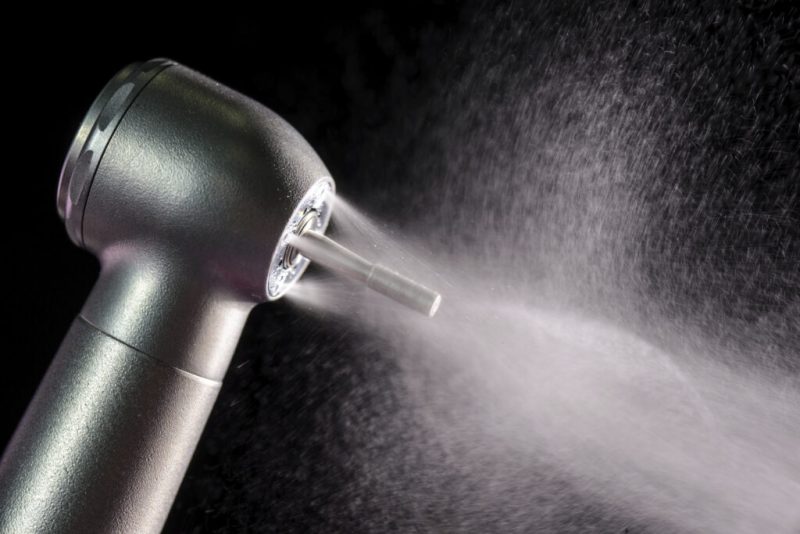
Dental Handpieces are a critical tool used in routine and complex dental treatments. Inside the head of a high-speed handpiece, a turbine the size of a fingernail spins at speeds that would cause most mechanical components to fail within seconds — yet these instruments are expected to perform with clinical precision dozens of times a day, every day, for years. That reliability is the product of extraordinary engineering, and it makes them one of the most technically sophisticated tools used in routine healthcare.
This complexity, however, creates one of the most difficult infection control challenges in dentistry. Contamination that has entered its internal components during use is invisible, inaccessible and, without the right protocol, will remain there through the autoclave cycle.
How dental handpieces become contaminated
The internal channels of the dental handpieces can become contaminated from suckback, also known as retro-contamination.
While the handpiece is in operation, positive air pressure keeps the internal channels flowing outward. Air and water move through the instrument and exit at the bur tip. This outward pressure prevents anything from the patient’s oral environment from travelling back into the instrument. As soon as the air supply cuts, pressure inside the handpiece drops.
This brief negative pressure pulls back blood, saliva, tissue debris, and oral micro-organisms through the bur orifice into the internal channels of the instrument. Handpieces are fitted with anti-retraction valves to prevent sucback, however these valves are known to fail.
What evidence is there to illustrate the risk?
The risk of internal handpiece contamination is not theoretical. Several peer-reviewed studies have directly measured what is present inside used dental handpieces taken from active clinical practice — and the findings are consistent.
Three handpiece types were dismantled and their internal components tested using orthophthalaldehyde assay, SDS-PAGE, mass spectroscopy, Western blotting and ELISA. Mass spectroscopy confirmed the surgical gear contamination was predominantly serum-derived — patient blood.
Used, unprocessed handpieces were dismantled aseptically, immersed in phosphate-buffered saline, ultrasonicated and cultured for live bacteria.
Isolates included oral streptococci, Pseudomonas spp., and Staphylococcus aureus.
Spray-water samples were collected from handpieces in seven real dental offices — both before and after patient treatment — measuring protein concentration across 398 samples using the BCA assay.
Why does sterilisation not fix the issue?
This is the question most professionals ask when first seeing this evidence. If the handpiece goes through a sterilisation cycle, has the contamination inside has been dealt with?
The answer is no due to one of the fundamental pillars of infection prevention and control, what is not clean cannot be sterilised. Sterilisation eliminates microbial life. It does not remove the physical material, such as the blood, protein and tissue debris that suckback has deposited inside the handpiece.
Steam sterilisation works through direct contact: the steam has to physically reach a surface to sterilise it. Where contamination forms a layer over a surface, it acts as a barrier that the steam cannot penetrate.
Additionally, when blood protein is exposed to autoclave temperatures without being cleaned off first, it doesn’t disappear — it bonds to the surface it’s sitting on. In effect it becomes baked on. This is why water temperature should not exceed 45 degrees when manually cleaning or using an ultrasonic bath. The contamination that was removable before the cycle is now fixed to the internal surfaces of the instrument, and harder to remove than it was to begin with. Over time this burnt on material can damage the delicate internal components of the handpiece.
The type of autoclave used also has a baring on the handpiece decontamination process.
How to effectively decontaminate a handpiece internally
Several effective methods exist for internal cleaning and disinfection before sterilisation.
Washer Disinfectors
Washer-disinfectors have excellent supporting evidence for internal handpiece cleaning and disinfection. A 2022 study showed “an approximate 5 log or greater reduction in microbial cfu and a >93% reduction in protein from DHP heads and channels was consistently recorded following washer-disinfection for all DHPs under all conditions tested.”
For effective cleaning and disinfection of handpieces in washer disinfectors a few key rules must be followed.
- Always follow manufacturers guidelines, not all handpieces are suitable for use in a washer disinfector.
- Handpieces must be placed on the handpiece stand.
- Check the pH level of your detergent. Any value over 10.5 will be too harsh and can invalidate your warranty.
- Oil the handpiece after processing in the washer disinfector, not before.
- Remember disinfection is NOT sterilisation. Handpieces must still be sterilised after washer-disinfection.
Manual system
In lieu of a washer-disinfector, a manual handpiece cleaning and disinfection system can be implemented.
The WL system is our state of the art handpiece cleaning and disinfection system. WL will completely remove any blood or debris in the handpiece. WL-Clean cleans the internal surfaces, WL-Cid disinfects with broad-spectrum antimicrobial activity (including any enveloped viruses such as coronavirus), finally WL-Dry blows out any leftover solution or tissue ready for lubrication with an oiling solution.
The WL-System has been tested to EN ISO/TS 15883-5 and has been proven to be as effective as a washer-disinfector for internal handpiece cleaning/disinfection.
Internal contamination of handpieces is now a known and evidenced issue. Handpieces are a potential transmission risk for several diseases. Adopting a handpiece internal cleaning and disinfection protocol will future-proof your practice and protect your staff and patients.
References
- Smith A, Smith G, Lappin DF, et al. Dental handpiece contamination: a proteomics and surface analysis approach. Biofouling. 2014;30(1):29–39. PMID: 24138163
- Smith G, Smith A. Microbial contamination of used dental handpieces. Am J Infect Control. 2014;42(9):1019–1021. PMID: 25179340
- Schalli M, Platzer S, Schmut R, et al. High-speed dental instruments: an investigation of protein-contaminated dental handpieces with the bicinchoninic acid assay in dental offices in Styria, Austria. Int J Environ Res Public Health. 2023;20(3):2224. PMC9914004
- Sterilization of dental handpieces. Am J Infect Control. 2017. Confirms non-vacuum autoclaves cannot sterilise handpiece internal components. View article
- Smith GWG, Smith AJ, Creanor S, et al. Survey of the decontamination and maintenance of dental handpieces in general dental practice. Br Dent J. 2009;207(4):E7. View article
Free Decontamination Review
Need help with transportation or any part of the decontamination cycle? Get a free review of your decontamination procedures from our expert team — fully tailored to your practice.
Book Your Free Review →Completely free